Design Agencies – Elmwood

Elmwood is a graphic design agency that mainly works on branding projects and has the ethos of “It’s no longer good enough to be the best of the best, you need to be the only ones who do what you do…”. They have 5 different studios across the world from Leeds to Melbourne. As it is a design agency they have a lot of variety in style of work that they produce for different projects to fulfil the different briefs.

This is an example of one of their most recent pieces of work. This is packaging for a coffee and they have thought outside the box and gone away from the typical coffee packaging that is used on other brands and created a detailed sketch of a skull in dark grey and black and then contrasted it with a bold purple label. I like this packaging design as I think it really stands out from other companies and catches people’s eye straight away.

Photography

For this image I wanted to show the atmosphere at the concert through the picture so had a silhouette of hands coming from the bottom and then captured the detail in the confetti falling. I also digitally edited the image to make the bird symbol in the top left corner look more fluorescent and stand out from the darkness at the bottom of the image.

For this image I wanted to capture the atmosphere in the picture as well. I took the same approach of having the crowds silhouette stand up at the bottom and then have the main stage in the background. I made the contrast between the front and the back be bolder by turning the image into black and white and editing the levels to make the lights appear brighter and the silhouettes appear darker to create a strong contrast. I like this image as the closer you look the more details you can see from the crowd where as from a distance it just looks like one element.

Hannu Huhtamo – Light painting

Hannu Huhtamo is a photographer that uses the technique of light painting. This involves have a light source such as a torch or a sparkler.

The images he produces are of the light path than is created when he moves the light source and it is captured on a camera by having a long exposure setting so that the camera’s shutter speed is long. The slower the shutter speed the more light the camera will pick up. These pictures can be taken with a shutter speed of a few seconds or even hours. The shutter speed Hannu uses symmetry and floral patterns to create his images. By using floral patterns gives the light sculpture an organic look. The pieces all consist of lots of contrast as for the light to be picked up there needs to be a dark background so the neon vibrant light contrasts with the background. To create this type of photography a DSLR camera is needed and a tripod. Tripods are useful for all elements of photography so that you can get a steady camera that will produce clear images. One good use of tripods is when taking pictures of sunsets and night-time as to reduce the amount of light intake the photographer will adjust the exposure and shutter speed however by doing this it can cause camera shake which causes blurring. Using a tripod will minimalize this blur and produce a clear image.

Photography – Manchester’s Architecture

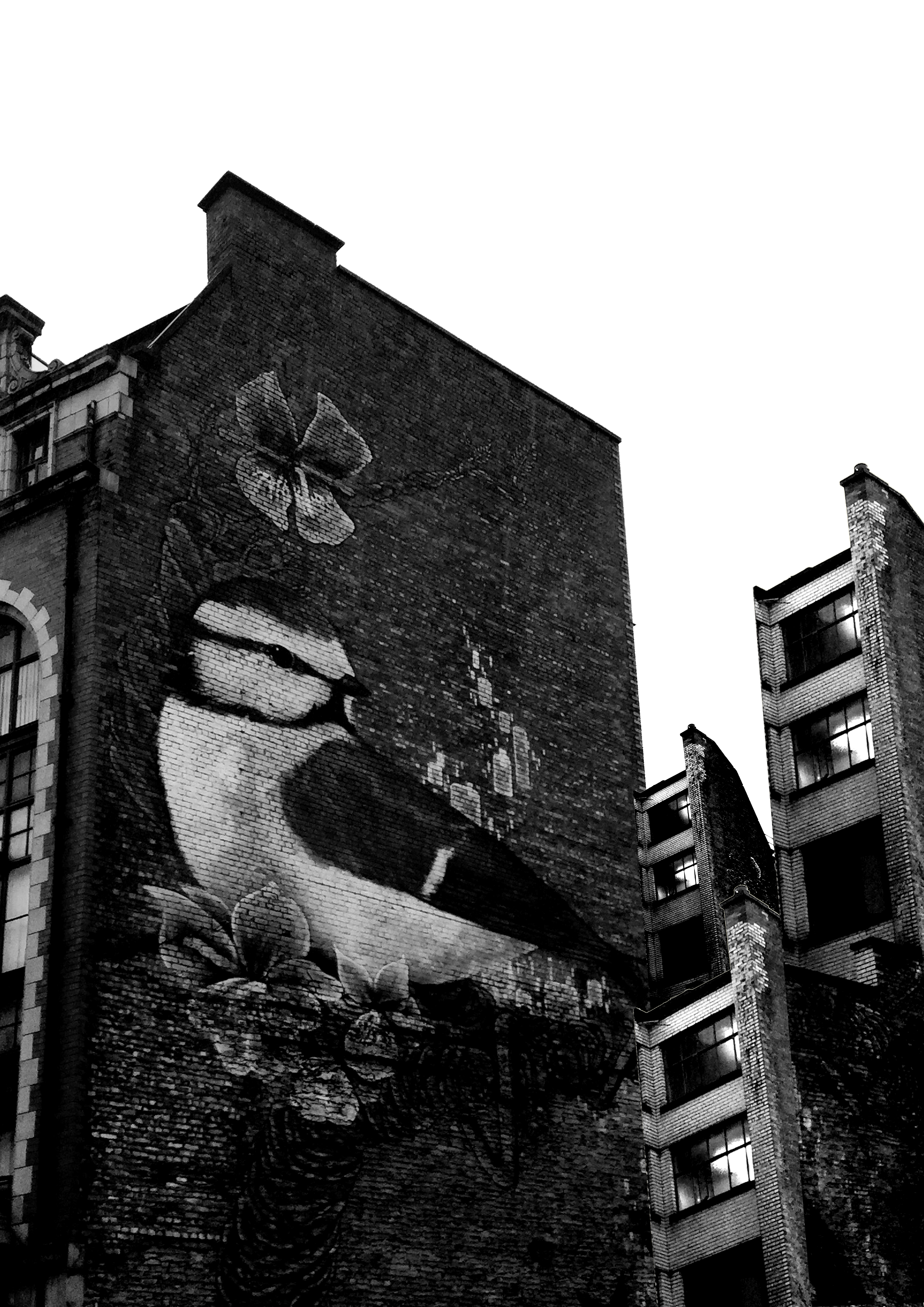
This is a selection of images taken in Manchester city centre that reflects the variety of different types of architecture and the contrast between old and modern structures.

This is an image took in Manchester. I took this picture as the architectural design of the arches create an interesting tunnel effect and the lights create a strong contrast in the light of the tunnel and the darkness of night. To make the image more effective I uploaded it to Photoshop and edited the levels and the colour to make the contrast higher and make the image black and white. I then created squares of the image layered over it to make it look like a collage of different images to make the focal point the end of the tunnel and the mysterious character.

This image captures how architecture in Manchester has changed as the building on the right looks very old and it is contrasted by the shiny and new apartment block in the background and then the scaffolding on the right side as well. I like how at the top of the frame you can see the branches from a tree are coming through onto the image which creates a strong contrast between nature and manmade. I like how the bottom left and right contain a lot of dark shadows but it is contrasted with a panel of white going through the middle and across the top.

Infographics – David McCandless

An infographic is a visual representation of information or data, such as a chart or diagram.

David McCandless is a journalist that takes lots of information and data that is hard to process and understand and reinterprets the confusing data and turns them into a simple understandable infographic. McCandless got his inspiration from being a journalist himself and finding it hard to understand large amounts of data and didn’t know how to be able to word different perspectives within one article but manage to still keep it interesting and easy to follow so he decided to start drawing it out so he could visually see connections between information and data. From then he has created hundreds of infographics about a range of different subjects from dogs to politics. 

One example of his work is the infographic on global carbon footprint. This is a piece that from a first glance looks like a colourful foot print but as you look closer it highlights the different countries and their contribution to CO2 emissions. To create his work, he researches into masses amounts of data and then takes this data and reinterprets it into a simple and more understandable piece of infographic. He uses colour and geometric shapes to reinterpret the data from just a black and white to something bold and full of vibrant block colours to really make it stand out and to make people look and therefore aware of the issue of carbon footprint. In the piece, there is a lot of white space around the main image and it is positioned in the center of the piece to highlight the importance of the main visual and then within the white space there are thin lines leading to small thin font adding a bit of information. The mood in his work is very mixed due to the use of bright block colours and the use of rounded geometric shapes creates a positive mood and then it being contrasted with the black block colour which portrays a negative mood which reflects the context of the information as there are some countries that have a big negative impact of the amount of CO2 emissions but there also some with little impact which is good. At the side there is a key illustrating the difference and meanings behind the colours which he has created to ensure the work is completely understandable and clear.

From researching into David McCandless I decided to take inspiration to then create my own infographic to represent the amount of plastic bottles used in the UK for a project on plastic pollution.

To create my infographic I started with lots of thumbnail ideas and experiments but decided that this one was the best. I worked created the union jack flag out of the silhouettes of plastic bottles and worked out how many bottles needed to be coloured in to represent the 58%. I then used the paint bucket tool to colour this amount in red and still keep it to clearly show that it is the flag. I then did a small strapline at the bottom in red to show the statistic of 58% of bottles aren’t recycled properly each day. I took inspiration from David McCandless’ infographic and had a black background and contrasted it with white and red to make it stand out from a distance. I also thought it was clever how he created the outline of the foot to show carbon footprint so I thought the flag was a good way to represent that it is aimed at the UK.

Tim Burton

Tim Burton is a film director, producer, artists, writer and animator and is well known for his dark and gothic style of work on films such as Beetlejuice, Edward Scissorhands and Corpse Bride. He works has a very distinctive look and his signature look is for his characters to have very large rounded eyes. In his early years of his career Tim Burton worked on fox and the hound and was fired by Disney for not being able to draw in the Disney style so he then started creating his own work in his own unique gothic style.

“I’ve always loved people with expressive eyes. I like people that can express things without speaking. It’s like old silent movie stars. There’s something that’s quite beautiful about just looking into people’s eyes.”

This is an example of one of his characters from Corpse Bride. The unusual thing about this character is that even though she’s meant to be dead her skin is still a vibrant blue and she makes the other characters look dull. There is the strong contrast in the colour of skin or the bride and the other characters to illustrate the difference between the dead and living. The bright blue makes the film playfully dark which makes it appropriate for children.

Burton is well known for enhancing features of his characters to make them look unusual. With this character he has given her his signature large round eyes with small pupils and long eyelashes. She also has very large plump lips that are contrasted with the very petite nose. Also the head is very large compared to the next and makes it looks unbalanced but the large features on the face makes the head look so small due to the small amount of white space left. He creates his characters for films such as Corpse bride by using hand made models and moving it slightly to create each frame.

This is my favourite Tim Burton character; Jack the Skellington from a Nightmare Before Christmas. This character stands out a lot because of its extreme body composition as it is so tall but so thin and has extremely long limbs almost like a spider’s leg. The interesting part of this character is that even though it is a skull and has no eyeballs it still has very expressive eyes ad sticks to Burton’s distinctive look. I think its clever how he managed to still show the character’s mood with such minimal number of items on its face. I like how the character is very human like even with its clothes being like tuxedo and trousers. By having the character human like it makes it easy to relate to the character.

Edward Scissorhands is one of Tim Burton’s most well-known characters and the idea for the character came from a drawing that he had made in high school. The character is a very lonely character that is representing someone being misunderstood and it shows this through the sorrowful, dark sunken eyes and the stance of the character. Tim Burton understands that monsters aren’t just viscous creatures but explores the humanity side of it. 

This drawing looks very rushed and created without much thought but just created to represent his mood at the time. The character’s arms and legs are very thin and fragile which is contrasted by its broad shoulders. The hands are very thin and long and like garden tools than scissors which is used to emphasize the importance of them to the character. The high contrast of black and white around the eyes make them look more isolated in the dark and scared. The clothing on the character represents a bit of his character as well as his clothes are all ripped and messy showing the complications to having scissors for hands and reveals a bit of a story.This character is aimed at an older target audience which is shown through the lack of colour and the gothic imagery.

Graphic Design: Career Path and Progression

Working as a graphic designer will involve working on projects creating things such as advertising, web design, packaging, branding and many others. There are three different types of environments can work in as a graphic designer; in-house, agency and freelance.

A freelance graphic designer is a self-employed designer that works independently and has to seek out clients to get projects. Working as a freelance means that you have to do your own research, work plans and creative work. A benefit of working as a freelance designer is that you can pick and choose which jobs you want to do and most interested in. However, a negative about working as a freelance artist is that you have to constantly look for new jobs to be able to have a consistent wage and also need to build a good client base to get more jobs which can be quite difficult at first if you don’t have a lot of experience.

Working as a designer in an agency involves working as a team and everyone is usually in different departments in the agency such as the copywriting department that creates the strap lines and any text that goes on the project. There is also the art worker that creates the visuals and the creative director that is in charge of the agency and gives feedback on work with improvements for the copywriter and art worker to then change. A benefit of working in an agency is that there is a lot of variety in the work and there is also a lot of progression as you might start off as a junior and with more experience go onto becoming the art worker or even creative director. Another benefit of working in an agency is that if you’re ever struggling to come up with ideas or need an opinion then you can ask someone in the team. A negative about working in an agency is that there isn’t as much creative freedom as a freelancer would have and also people who work in an agency tend to get a lower salary than elsewhere.

An in-house graphic designer is one that works within a large organisation, for example publishers, retailers, universities, packaging companies and banks. A benefit of working in-house is that the salaries tend to be higher than in an agency and it’s easier to progress internally. However, there is usually not much variety in projects and less creative freedom than in an agency or freelance.

To be a graphic designer you need to have certain skills and qualities. Such as; creativity, originality, flexibility, resilience, strong knowledge of design programs, like photoshop, illustrator, InDesign, etc., ability to understand clients’ needs and find practical solutions, good teamwork skills, strong computer skills, strong artistic senses, ability to work to briefs, ability to multi-task on many projects at a time, ability to accept feedback, confidence in presenting and explaining ideas, ability to pay attention to detail.

Ryan Andrews

Ryan Andrews is a comic book artist that grew up in Southern California and now lives in Japan. Two of his comics, ‘Sarah and the Seed’ and ‘Our Blood Stained Roof’ have been honoured with an Eisner Award nominations in the Best Digital Comic category.

To create his work Ryan Andrew creates small thumbnails to quickly sketch out the different panels and then once he’s got the initial idea of what he wants to create he then copies the thumbnails onto a bigger piece of paper and takes more time on them to make them better quality than the first lot of thumbnails. He then uses a Bristol board and a Kuretake brush pen to create the final version. He starts off by sketching out the basic layout to make sure the composition and placement right. After the basic lines are drawn on with pencil he then goes in with his pen and adds the details. He then creates textures by using a piece of water colour paper and experimenting with watercolour paints to create a variety of different textures to then experiment with digitally using Photoshop. The benefit of editing it digitally to apply colour is that watercolours don’t work well on the Bristol board as they tend to run and also causes the ink to smudge and also using Photoshop allows you to experiment a lot more and gives you a variety of options and allows you to undo changes that you’ve made without ruining the whole piece. He creates the textures using a variety of materials such as brushes, rags, salt and anything accessible. He then scans the texture and drawing in to edit it digitally and uploads it to Photoshop. He then experiments with different settings such as multiply filter on the textured layer to have the texture over the image to add depth. Also uses masks to apply darker areas to add more tone and to create a 3D effect and also to highlight certain areas of the panel. He also creates silhouettes digitally by using the selection tool and then applying a gradient to give a 3D effect and add further details and to create a full scenery. He then repeats this process for each panel and then combines them all at the end to create a full comic strip.